
The Seventh Age of Email Deliverability
The latest evolution of email deliverability introduces a new layer of challenges that make it even harder for senders to consistently create relevant experiences and manage their sender reputation.
Before we dive into these new changes, which revolve around inbox providers’ use of AI summaries, let’s quickly put them in the context of other major changes that ushered in a new age of email deliverability.
First Age of Email Deliverability: There were no rules and few if any consequences for bad behavior. Email users were more or less at the mercy of senders, some of whom scraped, bought, and sold email addresses and didn’t always honor unsubscribes.
Second Age of Email Deliverability: Inbox providers used lists of bad senders (blocklists) and good senders (whitelists) to make sender-based filtering decisions. They also used lists of so-called “spam words” to filter emails that contained them, which had very mixed results.
Third Age of Email Deliverability: Inbox providers armed their users with the “report spam” button, which allowed them to block future emails from offending senders. Moreover, senders who had overly high complaint rates saw their emails junked or blocked across entire mailbox providers.
Fourth Age of Email Deliverability: Inbox providers expanded their filtering algorithms to also include positive signals of engagement, such as opens, clicks, forwards, and foldering. Email subscribers now must do more than tolerate marketers’ emails; they must at least occasionally engage with them, marking the beginning of a focus on list quality over quantity.
Fifth Age of Email Deliverability: Inbox providers attached sender reputations not just to brands’ sending IP addresses, but also to their domains. Because of this change, it’s now impossible for a brand to run away from a bad sender reputation.
Sixth Age of Email Deliverability: Inbox providers lowered visibility into engagement in the name of increasing privacy—chiefly, Apple via Mail Privacy Protection. This undermined senders’ ability to manage subscriber inactivity. But while many open signals were lost, senders gained auto-open signals, which indicate their emails are reaching their subscribers’ inboxes. Ironically, this has given some senders the confidence to dramatically loosen their inactivity rules.
Now Entering: The Seventh Age of Email Deliverability
The age we’re in now is characterized by marketers losing much of the prime real estate in the inbox. This space includes preview text, subject lines, and preview pane real estate. In some cases, this space is simply disappearing. But in most cases, it’s being lost to a variety of AI-generated summaries.
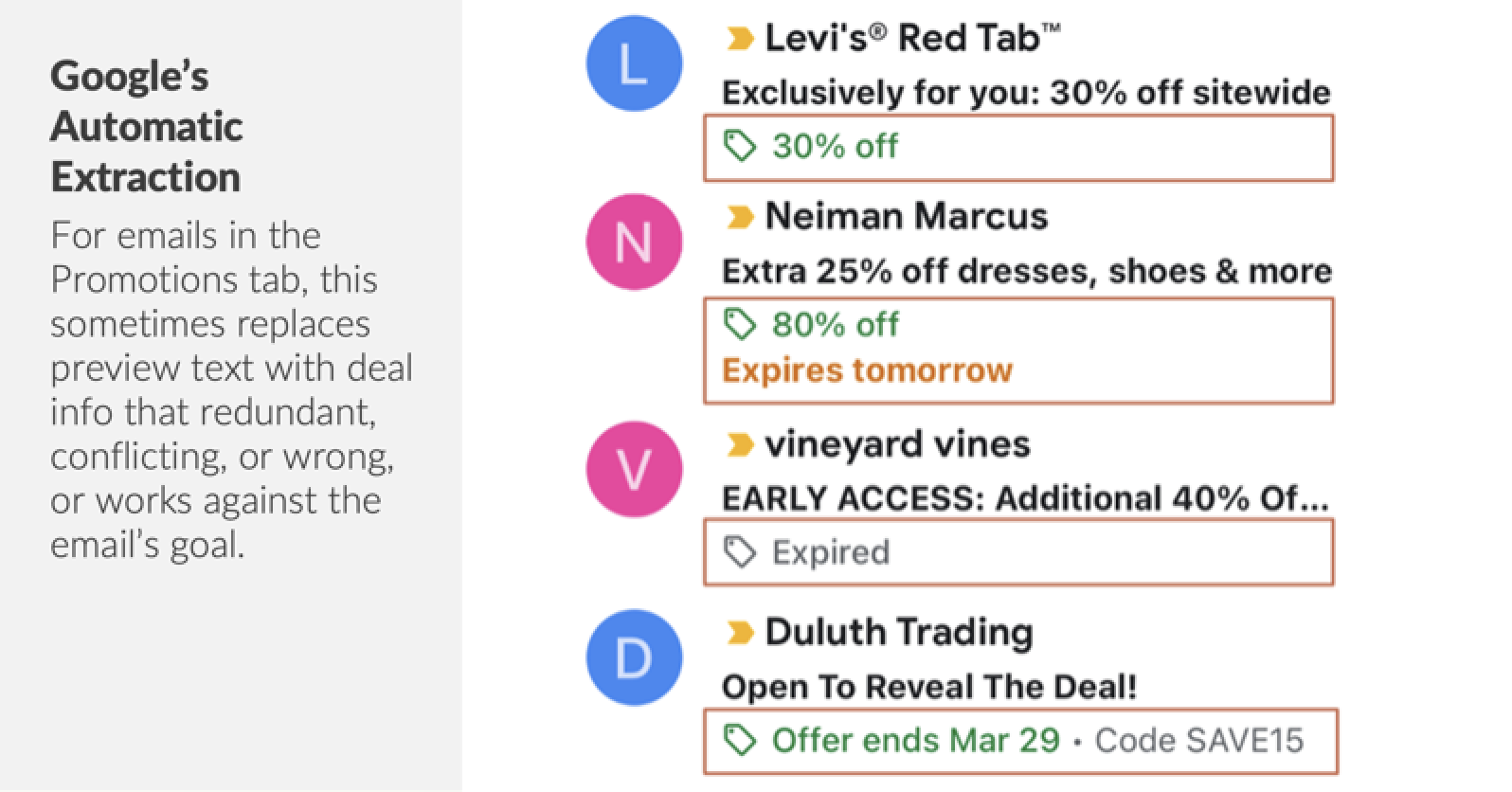
For example, Gmail uses Automatic Extraction to automatically apply Annotations code to promotional emails that replace preview text with deal summaries, product carousels, and single image previews. While brands can code Annotations into their emails, they’re not always honored. Neither brands nor users can opt out of Google using Automatic Extraction.
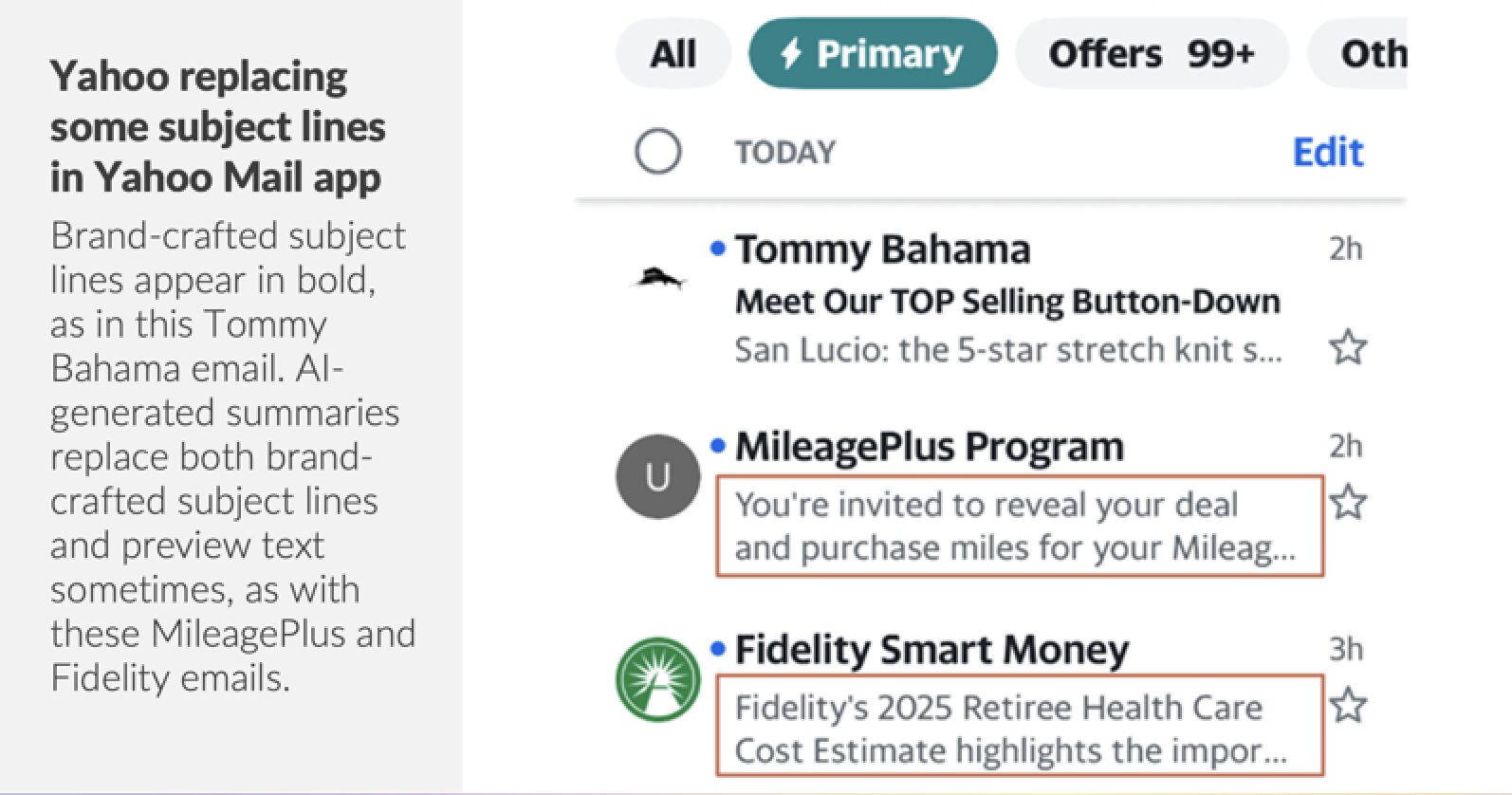
Yahoo Mail has been extracting information from emails similar to what Gmail has been doing, but they’ve also started to create AI summaries that replace both the preview text and subject line.
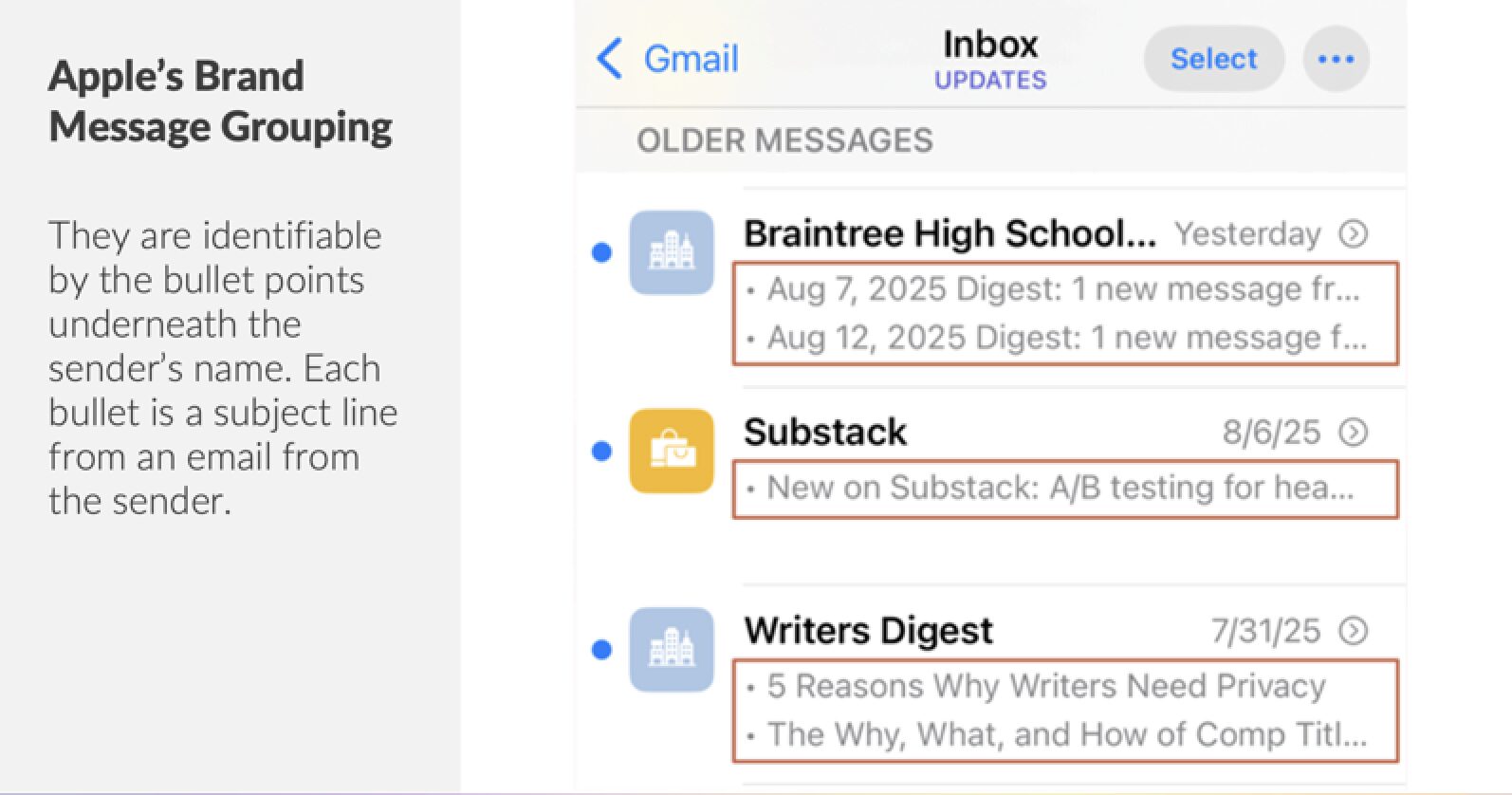
In addition to AI summaries that replace preview text, Apple Mail also uses Brand Message Grouping for “older messages,” where they roll up all of a brand’s emails under one item in the inbox. When this happens, only two of the subject lines are shown. Brands can’t opt out of having Brand Message Grouping applied to their emails, but users can opt out by selecting “List View” (rather than “Categories”), which also turns off tabs.
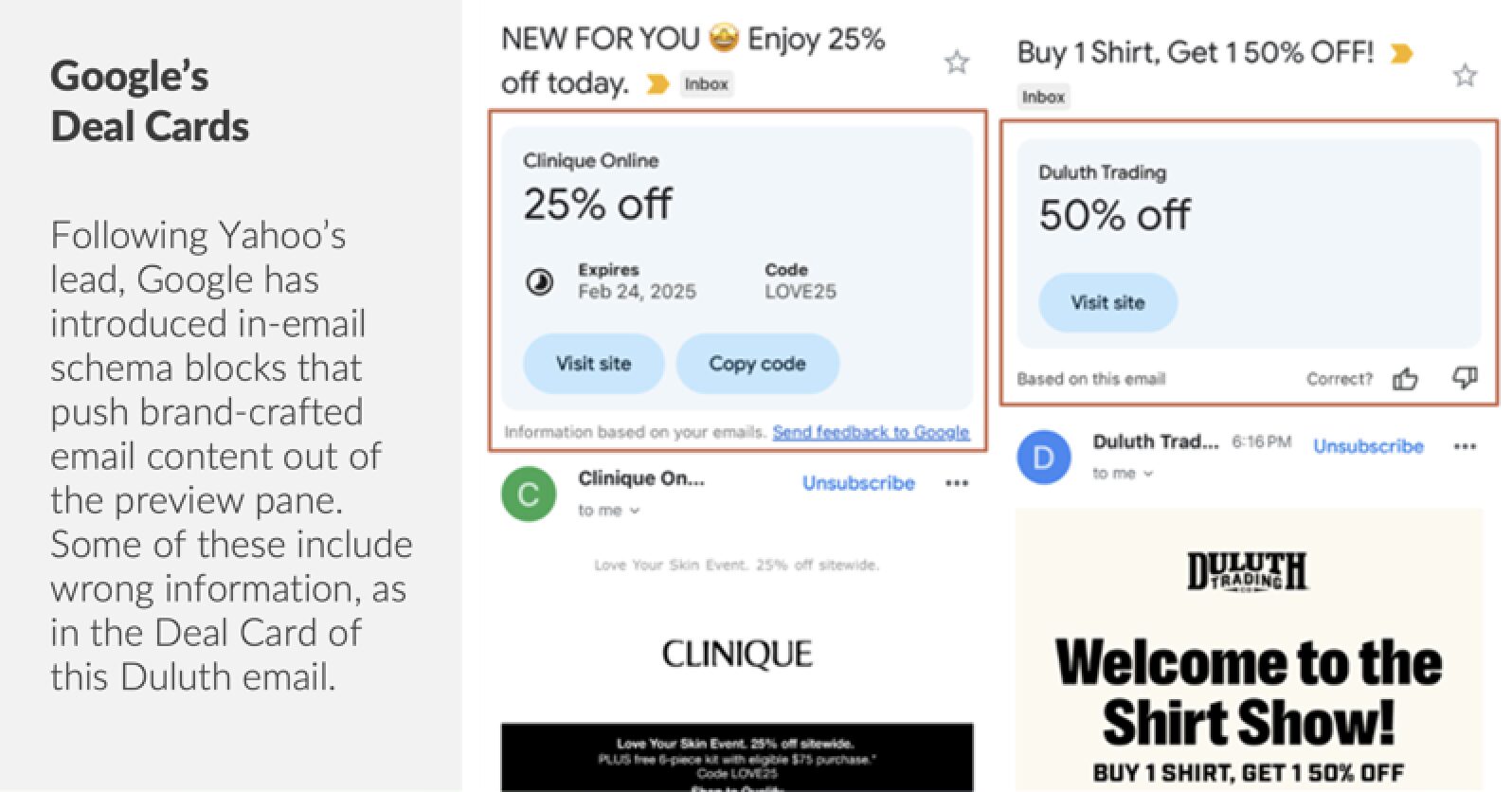
While much of the AI functionality that inboxes have added has taken away pre-open inbox real estate, some also take away post-open real estate. For example, following in the footsteps of Yahoo Mail, Gmail has added Deal Cards to some promotional emails that summarize the high points of the email’s primary offer, in much the same way that deal summary Annotations do in the inbox pre-open.
These Deal Cards push 40% or more of the email’s brand-crafted content out of the preview pane, which is the most valuable real estate in the inbox. Brands can now code Deal Cards into their campaigns but can’t opt out of the automatic generation of Deal Cards. Moreover, users can’t turn off Deal Cards either.
How to Manage Email Deliverability in the AI Age
Just as with past transitions, moving into the Seventh Age of Email Deliverability requires marketers to adapt their practices. Here are the four most important ones you should consider in order to continue successfully managing your deliverability.
1. Craft standalone subject lines
The best practice for more than a decade has been to back up and extend your subject lines with thoughtful preview text. Sadly, in this new age, your brand-crafted preview text is often not going to show up. That means you need to craft subject lines that don’t rely on your preview text to be compelling.
That doesn’t mean you shouldn’t write preview text, as it will still show up for some of your subscribers. But you should be wary of using subject line–preview text combos, such as having your preview text answer the question posed by your subject line, or having your preview text deliver the punchline for the joke set up by your subject line.
2. Avoid overly creative copy
If your email copy is overly clever or very figurative, there is greater potential for AI summaries to be confusing, misleading, or incorrect. Unfortunately, just like search engine optimization wrung all the creativity out of titles and subtitles, now AI summaries are wringing the creativity out of the rest of your copy.
Generally speaking, email copy has been trending shorter for a long time. Now you have another reason to be succinct and clear. More than ever, clarity is the name of the game when it comes to marketing communications.
3. Use schema selectively
Used by Gmail and Yahoo Mail, schema is only part of the AI summary equation. But it’s one where you actually have some control. On a per-campaign basis, consider whether following the schema coding recommended by Gmail and Yahoo Mail will increase the chances that any schema-powered content will be correct. If your email isn’t promoting a discount, then there’s no need to consider coding any schema into your email.
A bit of history—schema was initially launched as a carrot, an optional tool for brands to use. However, brands found it difficult to justify the extra effort in coding schema, given poor visibility into impact and inconsistencies in schema being honored. So, brands abandoned schema and usage was essentially zero.
For a variety of mostly self-serving reasons, inbox providers wanted schema to be used, so they started forcing it upon brand promotional emails. As a result, we’re now in the stick era of schema, where inbox providers are automatically applying it to promotional emails. Now brands have to use schema if they want to reduce AI-generated errors that confuse and disappoint subscribers and potentially hurt customer relationships.
4. Proactively monitor deliverability
Hopefully your brand is already monitoring its email deliverability on a regular basis. If not, these changes represent a heightened need to do so, because your email engagement could be depressed and spam complaints elevated by errors with inbox providers’ AI features, despite you not doing anything wrong.
Bonus strategy: Complain
The future belongs to brands that de-silo their organizations and speak in one voice. The usage of AI by inbox providers to replace and diminish the content of marketers’ emails is a prime opportunity to flex this muscle.
Because all the big inbox providers are also major advertising platforms, advertising teams should express their brands’ unhappiness every chance they get. Let Google, Yahoo, and Apple know that their actions as inbox providers are hurting your business and negatively impacting your perception of them as a trusted and valued partner.
The Seventh Age of Email Deliverability represents the continued erosion of senders’ control over their deliverability.
While Apple’s Mail Privacy Protection made it much harder for marketers to prioritize sending to engaged subscribers because it reduced visibility into engagement, inbox providers’ AI summaries are reducing the control of brands over the relevance of their messages.
Put another way: For the first time ever, when mailbox providers measure email engagement, they’re partially measuring the effectiveness of their own AI features. And when mailbox providers measure spam complaints, they’re partially measuring the frustration of their own users with their own AI features and how they impact their email experiences with the brands they care about most.
Want to see Zeta in action?