
Consumers Are Letting AI Into the Holiday Gift Aisle—Are You Ready?
This holiday season, AI is not only stepping into the role of a gift-giving sidekick; it’s becoming a co-shopper, an advisor, and in some cases, the silent decision-maker influencing what gifts are exchanged this season.
We recently surveyed 2,000 consumers who use AI tools at least monthly to learn how they use AI for gift giving. The results were clear: shoppers are turning to AI not just for inspiration, but for decision-making, stress relief, and even sentimental tasks.
The findings reveal a fast-growing reliance on AI in holiday shopping—and a clear call for marketers to adapt or risk falling behind.
Key Findings
AI has entered the mainstream
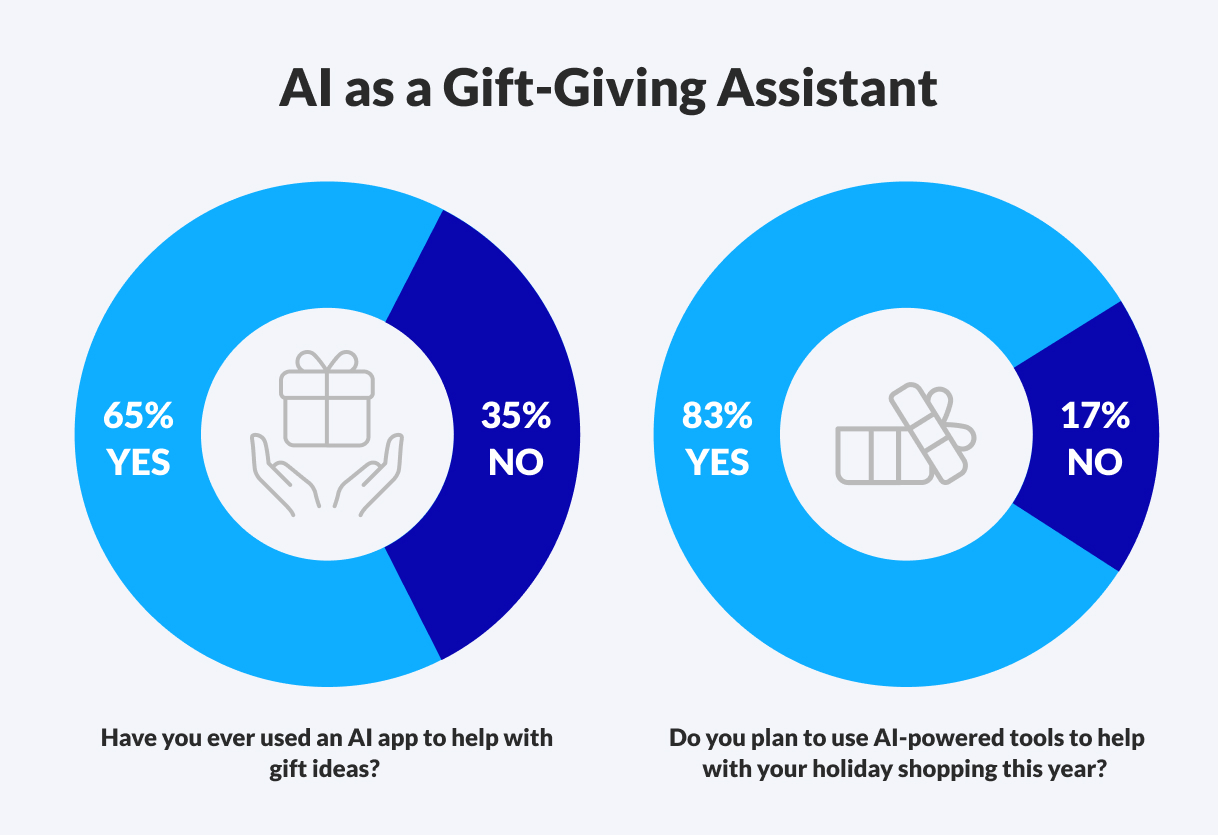
AI has officially entered the mainstream: 65% of AI users have already turned to tools like ChatGPT, Claude, and Google AI to generate gift ideas, and an even larger 83% say they plan to use AI for their holiday shopping this year.
AI is no longer a novelty in retail; it’s becoming a core part of the shopping experience. This shift marks the early stage of Agentic Commerce, where AI isn’t only influencing shopping decisions, but beginning to take autonomous actions on behalf of consumers. Retailers must prepare for the moment when the customer is both human and machine.
While enthusiasm spans the board, there are measurable differences by gender: Men are slightly ahead of women in their use of AI for gifting—with 67% of men reporting prior usage compared to 62% of women. Looking forward, the gap holds: 85% of men plan to use AI for holiday shopping, versus 81% of women. These aren’t seismic differences, but they underscore that male shoppers may be quicker to adopt AI-powered tools when it comes to gift discovery.
And it’s not just about whether consumers are using AI, but how. Many are relying on AI for high-consideration categories like electronics (70%), apparel (58%), and toys (58%). Others are turning to AI for experience-driven gifts such as travel (44%) or even sentimental support, with 62% saying they’d use AI to help craft cards or notes to accompany a gift.
These behaviors show that adoption isn’t limited to one-off experiments; it is already embedded in both the practical and emotional layers of gifting.
Consumers trust AI for shopping help
For AI to become a true holiday shopping companion, consumers need to believe in it—and the data shows they do. Three out of four consumers (74%) say they would trust an AI product recommendation as much as one from a friend. That’s a striking signal that AI has broken through a trust barrier that many emerging technologies struggle with.
Trust, however, is not evenly distributed. Shoppers with less formal education are the most likely to trust AI at the same level as friends:
- 51% of an elementary school education
- 53% of those with only middle school education
- 54% of high school graduates
By contrast, college-educated consumers are more skeptical and don’t express the same level of trust:
- 38% of bachelor’s holders
- 35% of postgraduates
This educational divide suggests that while AI’s credibility is broadly strong, more educated audiences may need reassurance, transparency, and human validation to fully buy in.
For audiences with a high school education or less, AI already carries friend-level credibility. For college-educated audiences, skepticism means brands need a new muscle: explainability. The retailer who can open the black box will win over the discerning segments that control a disproportionate share of spend.
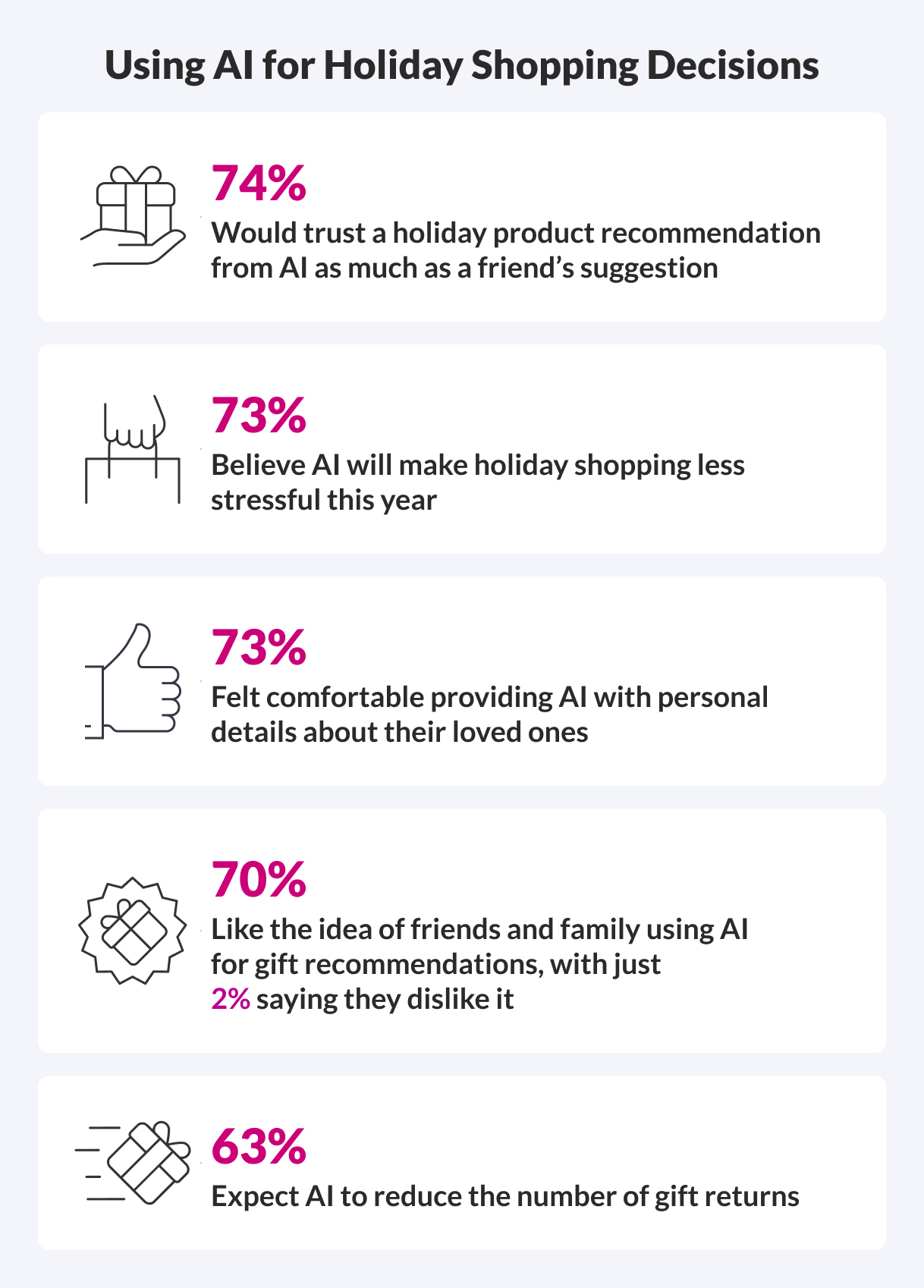
When it comes to personalization, consumers are open—even enthusiastic. 73% are comfortable sharing personal details about their friends and family with AI in order to improve gift recommendations.
This willingness is strongest among mid-income households ($50–54k at 85%) and lower education groups, but again, it dips among the most educated: only 47% of bachelor’s degree holders and 46% of postgraduates feel comfortable feeding intimate details into the algorithm.
This matters because gift giving is inherently personal. While many shoppers are ready to let AI shoulder the cognitive load of gift discovery, a sizable segment still wants reassurance that their data will be used responsibly, and that AI is an assistant—not the decision-maker.
AI is a stress reducer and experience amplifier
Consumers expect AI to do more than generate ideas. They see it as a tool to make the shopping process smoother, less stressful, and more efficient.
A strong majority—73%—say AI will make their holiday shopping less stressful. The sentiment is particularly pronounced among middle school respondents (82%) and PhDs (79%), suggesting that shoppers on opposite ends of the education spectrum are especially receptive to AI’s stress-busting potential. In contrast, skepticism is highest among master’s degree holders (65%), continuing to highlight that even within educated groups, openness to AI varies.
AI is also seen as a way to cut down on gift returns, with 63% of consumers expecting AI to help them choose more accurately. Confidence is highest among mid-income earners. Belief in AI’s power to reduce returns drops off among higher earners ($95–99k at 56%) and the highly educated.
At the same time, there’s a tension: while many welcome AI’s efficiency, some worry it strips away the “magic” that makes holiday shopping feel special.
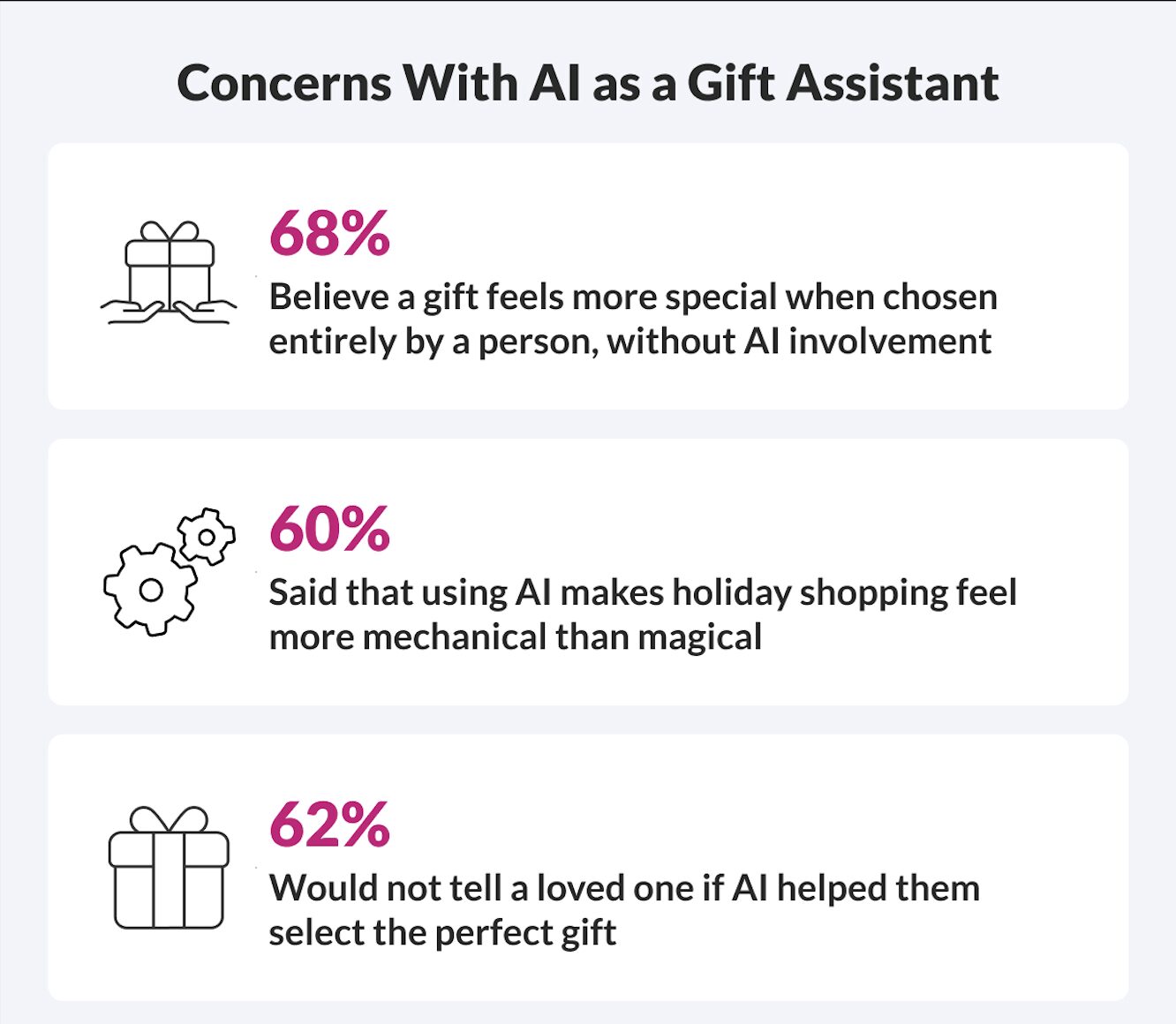
Perhaps the most telling tension is in how consumers feel about the experience of shopping with AI. 60% say AI makes the process feel more mechanical, while 40% say it makes shopping feel more magical.
Retailers that erase the friction but not the magic will win here! Education again plays a decisive role: lower education groups (middle school 40%, high school grads 37%) are more likely to feel that AI adds magic, while higher education groups (bachelor’s 27%, postgrad 24%) tilt toward the view that AI makes shopping sterile.
This split illustrates one of the central challenges for brands: AI is solving problems of stress and efficiency, but without careful framing, it risks undermining the very sense of joy and connection that makes holiday shopping unique.
Shoppers are willing to adopt new features
Shoppers aren’t just dabbling in AI—they’re ready to adopt advanced features that make the online shopping journey smoother, smarter, and more immersive.
Virtual try-on
The clear standout is virtual try-on, with 83% of consumers open to using AI to preview clothing or accessories before they buy. This isn’t just curiosity—it’s a signal that shoppers are actively seeking tools that build confidence in their purchases.
The strongest support comes from mid-income households, where adoption intent peaks at 98% among $45–49k earners. By contrast, openness drops among very low-income shoppers ($5–9k at 71%) and among those with higher education, such as bachelor’s degree holders (70%) and postgraduates (66%).
These splits suggest that while virtual try-on has mass-market appeal, the value proposition may need to be framed differently: as a fun, magical feature for some, and as a practical fit-checker for others.
Automated purchases
Consumers are also warming up to the idea of letting AI handle small, routine transactions. Nearly 60% say they are comfortable with AI automating simple purchases, such as reordering frequently bought items.
While this doesn’t carry the same emotional weight as gift discovery, it reflects a growing trust in AI to manage the mundane parts of shopping and creates an entry point for brands to build long-term loyalty through convenience.
Opinions vary on gift giving and receiving
AI may be an accepted shopping tool, but consumers have strong opinions about what role it should play in choosing gifts—and how much of that role they want others to know.
When asked what kind of “perfect gift” AI should help find, consumers split between two distinct desires:
- Roughly half prefer surprising gifts that delight and feel unique.
- While about a third prefer practical gifts that are safe and useful.
Even with this openness, the “human touch” still carries weight. 68% of consumers say gifts are more special if they’re wholly human-originated. Men are slightly more likely than women to hold this view (71% vs. 66%), signaling that concerns about authenticity and effort remain important in the gift exchange.
That tension comes through most clearly in whether givers admit to using AI. 62% say they would not tell if AI helped pick their gift. This instinct to keep AI’s role quiet is sharpest among the college-educated, with only 32% of bachelor’s and 29% of postgraduates willing to disclose.
In other words, even as AI becomes more mainstream, many givers still see its involvement as something best kept behind the scenes.
The irony is that recipients don’t mind. In fact, most welcome it. 70% of consumers like the idea of receiving an AI-chosen gift (only 2% say they dislike the idea), and a full 85% say they would be happy or indifferent if one landed in their hands.
Together, these findings show the gap between giver anxiety and recipient openness. Shoppers worry that AI undermines the thoughtfulness of the gesture, while recipients are largely focused on the end result: a good gift with a personal touch.
Consumers are quick to forgive AI mistakes
Consumers aren’t holding AI to impossible standards. If an AI recommendation misses the mark, most shoppers are quick to shrug it off rather than sour on the technology.
When asked how they’d respond to a bad AI gift recommendation:
- 44% said they would blame themselves for not using better judgment.
- 41% said it wouldn’t change their view of AI at all.
- 15% said they would distrust AI in the future.
In other words, consumers are largely forgiving—treating AI as a helpful tool that occasionally gets it wrong, not as a system that must always be perfect.
That same mindset carries through with returns. 44% of consumers say they would feel less guilty about returning a gift if AI had recommended it.
Rather than feeling bad about rejecting a friend or family member’s effort, shoppers see an AI-powered misfire as something they can return without emotional baggage. This finding reinforces the idea that AI reduces the stakes of gift giving; it’s less personal if the gift doesn’t land, which makes returns less fraught.
Taken together, these insights show that AI comes with a margin of error consumers are willing to accept. For marketers, that means the risks of introducing AI-powered shopping experiences are low—shoppers don’t expect perfection, and they don’t hold mistakes against the brand or the technology.
Recommendations and Implications for Marketers
Now that we’ve covered the key findings from the survey, let’s discuss what this means for marketers, and how to adapt.
1. Meet consumer adoption with scalable AI experiences
Consumers are already using AI to plan their holiday shopping. That means AI is no longer a differentiator; it’s a baseline expectation.
What to do:
- Introduce AI-powered shopping assistants (like gift finders, conversational search, guided recommendations, or highly returned items).
- Position them as time-saving tools for men (who show slightly higher adoption) and as thoughtful helpers for women (who value personalization).
- Focus AI features on mid-income households, who are the most eager adopters.
2. Build trust through transparency and control
Trust in AI is strong overall, but there is skepticism. More educated consumers want reassurance that AI isn’t a black box.
What to do:
- Clearly communicate how recommendations are generated and why certain products are being surfaced.
- Provide easy opt-outs and data-use explanations to make personalization feel safe, not intrusive.
- Blend human validation (staff picks, user reviews, etc.) alongside AI suggestions to close trust gaps.
3. Lean into feature openness
Automated purchases and personalized offers are widely embraced, but with important nuances.
What to do:
- Automate purchases: Start small with low-risk categories (everyday staples, consumables, etc.). Position auto-purchase as a way to remove friction, not remove choice.
- Personalize offer timing: AI decides when to trigger a promo based on shopper signals (e.g., browsing late at night, payday cycles). For retailers, this protects margin by serving discounts only when needed.
4. Balance efficiency with emotional value
Consumers love that AI reduces stress and returns, but many also fear it makes shopping too mechanical.
What to do:
- Design AI flows that still feel human and warm. Pair recommendations with lifestyle content, storytelling, or influencer voices. Use consumer product reviews to make your storytelling more personal.
- Highlight stress-busting benefits (“AI helps you shop faster, avoid mistakes”) while reinforcing that the shopper is still in control.
5. Offer dual paths: Surprise vs. practical
Consumers are split between wanting AI to help with surprising, delightful gifts vs. practical, safe bets.
What to do:
- Build choice into the journey: give shoppers a “Surprise Me” path and a “Safe Choice” path.
- Market AI as both inspirational and reliable—it’s about letting the shopper decide which role it should play.
6. Bridge the giver–recipient gap
Shoppers hide AI’s role out of fear it looks less personal, while recipients don’t mind at all.
What to do:
- Normalize AI’s role by framing it as a helper, not a replacement: “Found with a little help from AI.”
- Shift messaging to focus on the thoughtfulness of the outcome, not the process. Recipients care about the gift itself, not whether it came from a human or a machine.
7. De-risk AI adoption by highlighting forgiveness
Consumers are forgiving of AI mistakes and even feel less guilty about returns when AI was involved. That’s a green light for brands to experiment.
What to do:
- Launch pilot AI features confidently—shoppers don’t expect perfection.
- Pair AI with easy return policies to reduce perceived risk and encourage trial.
8. Extend AI into sentimental touch points
AI isn’t just for transactions—it’s creeping into the personal side of the holidays. Many consumers, especially women, are open to AI-written cards and notes.
What to do:
- Create AI-assisted writing tools for messages, captions, or notes that consumers can personalize.
- Market these tools as enhancements, not replacements: “AI helps you say it better.”
9. Prepare your brand for GEO (Generative Engine Optimization)
As consumers turn to AI assistants for shopping inspiration, brand visibility now depends on GEO. When shoppers ask AI for gift ideas or product advice, it isn’t returning links, it’s generating answers. If your brand’s data isn’t structured and accessible to those systems, you won’t show up in the response at all.
What to do:
- Structure and syndicate your data. Use clear schema markup for products, pricing, and reviews, and keep that information consistent across your site, merchant feeds, and review platforms. AI models rely on structured, credible data to surface answers.
- Create content that answers real questions. Write for natural language—“best gifts for new parents,” “eco-friendly beauty brands,” etc.—so AI can connect your content to human-style prompts. Authentic tone, transparency, and updated pages boost trust.
Meet Adoption with Scalable AI Shopping Tools
The holiday shopping landscape has reached a tipping point: AI is no longer optional, it’s expected. The real challenge is scaling AI that feels both useful and human.
Consumers assume brands will provide smart, seamless, and even emotional experiences powered by AI. Meeting those expectations requires more than good intentions, it demands technology that can handle personalization at scale, balance efficiency with empathy, and earn consumer trust.
Retailers can’t deliver this with siloed tools or surface-level automation. They need platforms that integrate clean data, real-time decisioning, and multichannel orchestration, with AI at the core. Only then can brands deliver AI experiences that feel both useful and human—reducing stress, cutting returns, and still leaving room for the magic of gift giving.
Learn more about how Zeta provides AI at scale for retailers.
Methodology: The 2025 Holiday Retail Survey was conducted online in September 2025 among 2,000 U.S. adults who report using AI tools at least monthly.



Want to see Zeta in action?