

Holiday 2025 Shopping Results: Black Friday and Cyber Monday Trends Shaping Retail
2025 has been another turbulent year: tariffs, inflation, and rising costs across all segments, particularly costs of living. Consumers are understandably cautious and watching their dollars.
But every outlet was predicting a record-breaking holiday shopping season.
So, what actually happened? In this article, we’ll first outline what we expected and then dive into the actual results from Cyber Week 2025.
Cyber Week 2025 Predictions
With only 26 shopping days this year, we expected the season to be fiercely competitive for retailers. The National Retail Federation (NRF) was predicting this holiday season—defined as November 1 to December 31—to exceed a trillion dollars for the first time, accounting for growth between 3.7% and 4.2%. For reference, the 2024 holiday season sales increased 4.3% over 2023 to reach $976.1 billion.
To get a consumer perspective, every year we ask U.S. consumers about when, where, and how they plan to shop. Here were the key findings:
- Consumer interest in Black Friday varies: In 2022, around half found it compelling. Interest has dropped every year since. But 2025 rebounded slightly, with 34% saying Cyber Week is compelling (up from 32% last year). Though it doesn’t really matter if consumers like Cyber Week; many participate regardless.
- There’s a pullback of big spenders: 33% said they planned to spend more than $1,000 on holiday shopping this year (down from 45% last year). Where 2022 and 2023 spiked in the less than $100 category, and 2024 surged for $1,000+, this year is more evenly split between low and high, at 34% and 33% respectively.
- Only 30% said they planned to do their holiday shopping online (a four-year low, down from 43% in 2024). Discount and department stores both had increased interest.
- Shoppers planned to start buying earlier this year: 43% of consumers said they won’t start their shopping until December, down from 53% last year. Nearly 20% were planning to start their holiday shopping during Cyber Week.
Overall, this indicated a huge Cyber Week, with significant online spend. And spoiler: That’s exactly what happened.
Let’s now dive into what actually happened during the Black Friday/Cyber Monday weekend.
Cyber Week 2025 Results
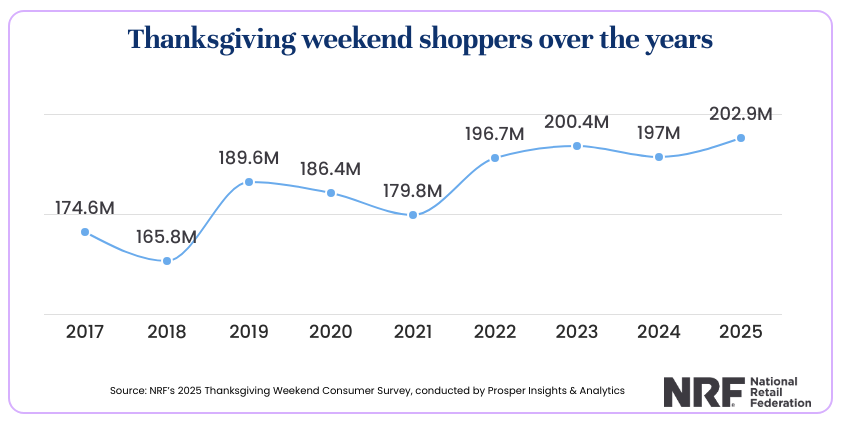
According to NRF, a record 202.9 million consumers shopped during the holiday weekend. This is an increase from 197 million last year (and even surpasses the previous record of 200.4 million from 2023). This also blows the NRF’s initial expectations of 186.9 million out of the water.
We won’t know until year-end if the $1 trillion number was met, but based on Cyber Week, it seems likely.
Holiday 2025 Shopping Trends
Let’s now talk about the biggest trends and surprise results from retail’s biggest weekend.
Online jumped, but in-store kept its footing
One look at an email inbox would imply that Cyber Week is all about online, but it couldn’t be further from the truth. Yes, consumers take advantage of online deals, but foot traffic is holding its ground.
NRF reports that 129.5 million consumers shopped in-store, up 3% from 2024’s 126 million. Online saw 134.9 million shoppers during Cyber Week, up 9% from last year. Many consumers took advantage of deals both online and in-store.
Interestingly, for the second year in a row, Black Friday accounted for more online sales than Cyber Monday.
Our holiday consumer survey from May indicated that only 30% of consumers said they planned to holiday shop online, but the actual results indicate that was an understatement. Though the top Cyber Week shopping destinations from NRF does align with our findings:
- 45% online
- 40% department stores
- 30% discount stores
But not everyone agrees about in-store. Preliminary data from RetailNext shows a 5.3% year-over-year decrease in retail foot traffic over the weekend. What we do know is that the days around Thanksgiving continue to be the busiest days of the year for brick-and-mortar retailers.
Mobile was a significant share of online sales
While online sales overall dominated the weekend, a large percentage of those sales happened on mobile devices again this year.
Mobile has become the most popular channel for online shoppers to browse and buy. NRF reported 46.9 million consumers shopped via their mobile device on Cyber Monday alone, up from 40.4 million last year—a 16% increase. This means a whopping 62% of Monday shoppers used mobile, which is on par with last year.
Just five years ago, only 41% of Cyber Monday spending was on mobile. This year, mobile accounted for over half of all Cyber Monday purchases, representing $8.2 billion in spend (up 8% YoY).
Black Friday was again the top sales day of Cyber Week
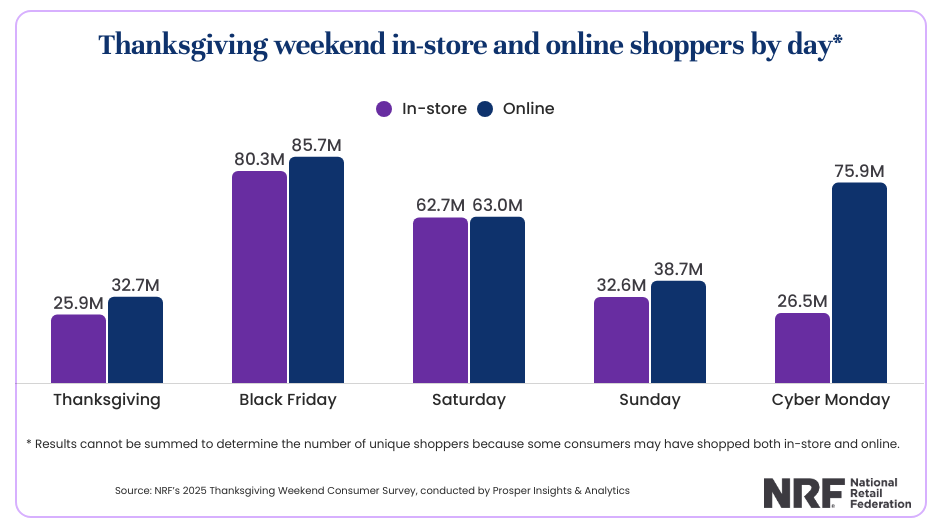
Black Friday holds the top spot not only for in-store traffic, but online sales as well, eclipsing Cyber Monday. NRF reports that Black Friday alone attracted 80.3 million in-store shoppers, and 85.7 million online shoppers.
But the whole weekend was busy. Saturday numbers were up slightly from last year. The Sunday after Thanksgiving drew a record 32.6 million in-store shoppers, a 27% increase over the 25.6 million of 2024.
And Cyber Monday brought 75.9 million online shoppers, compared to 64.4 million in 2024. Not surprisingly, Monday’s in-store traffic was the second lowest (just above Thanksgiving Day, when many stores are closed).
This tells us that while most consumers say the holiday isn’t compelling, they are hitting stores (and online shopping) in record numbers.
The interesting thing is that with each passing year, Cyber Week deals become more prolonged. Many retailers started promoting their holiday deals weeks in advance. And they don’t necessarily end on Cyber Monday like in years past.
So why is there so much activity on Black Friday? It could be that the deals really are that good, it could be that retailers have gotten more clever in their offers to encourage Friday shopping, and it could be partially tradition (or the fear of missing out).
Consumers continued to lean on alternative payments
Last year, consumer interest in credit cards increased by 303% in the week before Cyber Week and Buy Now Pay Later (BNPL) interest jumped 583% in the third week of November compared to the prior week, according to our own database of 245+ million U.S. consumer profiles.
This year, that same Zeta Data, based on online content consumption, told a different story; interest in BNPL flattened. Credit card engagement was more stable this year, but overall lower than 2024, indicating potentially reduced responsiveness to traditional financing or promo-driven card usage.
This flattening likely suggests that BNPL offerings have become so mainstream and integrated into the payment process that consumers have less need to seek out content about it. So while they are consuming content about BNPL at lower rates, use of the payment solution is on the rise.
Results from Cyber Week tell us that BNPL continues to surge as a payment option.
On Black Friday alone this year, BNPL usage was up nearly 9% YoY. For the season to date, spend through BNPL options is over $10 billion. Almost 80% of BNPL orders are on mobile.
This may be good for retailers, but not for consumers. BNPL allows consumers to spend, even if they don’t have the money to do so. Not only are credit card debt and loan delinquencies increasing, but a 2024 Stanford study found that “being offered BNPL by a favorite retailer powerfully predicts a shopper’s willingness to use it and that these users had an 8.9% increase in overdraft charges, a 2.5% increase in credit card interest, and an 8.4% increase in late fees.”
AI made its mark on holiday spend
This year, AI has gone mainstream, and with that comes new behaviors. We recently surveyed consumers who use AI tools and a staggering 83% said they planned to use AI to assist with gift-giving this year. Most felt that using AI would make gift-giving less stressful and would reduce the number of gift returns.
Consumers are also using AI to research options and find the best deals available. Several sources speak to increased traffic from AI tools (LLMs) to retailer sites in the 500-700% range compared to 2024. This would account for billions of attributed spend.
VP Retail, Zeta
Budgets remained strong, despite economic instability
This year’s holiday survey indicated a leveling out of budgets; significantly fewer consumers planned to spend over $1000, with that excess filtering into all the lower categories. Last year, 45% were within the $1000+ budget range, compared to 33% this year. More consumers this year, at 34%, planned to spend less than $100.
NRF data from Cyber Week aligned with that, indicating an average spend of $337.86 on items like gifts, holiday apparel, decorations, and other seasonal purchases.
This is an increase from $315.56 last year and is also the highest number since 2019. NRF states that approximately 67% ($225.74) was spent specifically on gifts this past weekend.
But with three weeks until Christmas, these numbers will surely increase.
The Final Stretch for Holiday 2025
Cyber Week may be behind us, but there’s still many shopping days until Christmas. Our survey found that 43% of people won’t start their shopping until December, and those who started early probably aren’t done yet. This means December has the potential to be a huge month for retailers.
The key is to stick to your plan, continue your outreach to consumers who are still looking for deals, and use AI to supercharge your efforts. And start thinking about how to continue to engage your new customers into the new year.
For more holiday tips and inspiration, visit our holiday marketing hub.
Want to see Zeta in action?